

When VÖLUR first conceived of their latest album Breathless Spirit, the world was a different place. What began as an exploration of The Saga of Grettir the Strong evolved over five long years into a deeply textured, emotionally sprawling album. Incorporating everything from doom metal and Mahlerian harmony to Persian and Kurdish traditions, field recordings, and Inuit visual art, Breathless Spirit stands as a rare achievement: immersive, conceptual, and fiercely human.
We sat down with the band to discuss how their understanding of Grettir—and themselves—shaped the emotional arc of the record.
“Breathless Spirit” evolved over five years—how did your understanding of The Saga of Grettir the Strong change during that time, and how did that evolution shape the album’s emotional arc?
Lucas: That’s a great question! I decided on the subject matter for this project in the winter of 2019, long before anyone could imagine a life filled with isolation, fear and loneliness. Grettir always appealed to me because of his haphazard charisma and his dealings with the supernatural. I like the idea of a kind of big oaf going headlong into strange mythical beasts.
But as the pandemic wore on, Grettir’s growing isolation and fear of the dark also took on a new perspective. His isolation, though, was fundamentally different from what most of us experienced. His story is about him running afoul of society and his curse comes from trying to fight a presence terrorizing the community. I’ve often maintained that ancient texts actually can’t really inform us directly about current things. I think it’s a more useful exercise in empathy across time than to say “ah look, he’s experiencing the same things as us.” In those cases, because we’re so removed from the actual context, you can twist anything the way you’d like it politically or emotionally.
And I’m not afraid to do that. I just like to acknowledge that I am doing it. While the story came to have a broader resonance, I tend to focus on the feeling of the prose and the feeling of the story. I’ve begun to change how I use texts as inspiration for music. The text can’t impede the music – that’s the first rule. Focus on emotion and atmosphere and make the challenge be the creation of those.
The album weaves Mahler, Persian and Kurdish forms, doom metal, and sound art into one cohesive whole. What challenges did you face in balancing these traditions without diluting their individual strengths?
Lucas: The challenge lies in not making it an insane aural assault on the level of Girl Talk or something like that. You want to have dynamics, you want to have textures, but you want them to appear as a whole. The method I used was to try to have a unifying tonal language. There’s really only two or three main themes on this record and they’re repeated and/or inverted throughout THe core tracks (Hearth, On Drangey and Death in Solitude) are all based around a movement of a major and minor second. While the other tracks (Windbourne Sorcery and Breathless Spirit) are based around a descending line. It’s my attempt at “exposition” as if it were a sonata. I will state unequivocally that this is not a sonata and that I don’t truly understand how a sonata works but sometimes you can work off a vague hunch or impression.
In terms of dilution, I’m not really sure. We’ve all heard fusion music that really grates on the ears, music that somehow captures the corniest aspects of the genres it’s fusing. I’m grabbing at straws but I remember Adorno lamenting the kind of world music pop that was being made in the sixties with sitars. That it only took a surface element from the instrument (literally the timbre) and just laid it over pop music so that these floating signifiers became devoid of context or meaning. But does that mean there’s a checklist you can go over to make sure you’re not doing hollow cultural appropriation? I don’t know. Speaking about the use of the Kurdish tanbur in “Windbourne Sorcery I” I hope I’ve shown proper respect and understanding to the instrument and to the people that play it. The use of 10/8, to me, makes it intentional, that there’s a REASON to have the instrument there. You want it to seem natural.
A great example is the use of 11/8 in “Here Comes the Sun.” It’s so natural and it comes from George’s study of Indian music and rhythms. It’s a marked shift from “Norwegian Wood” which is a nice song but it just had sitar slapped on it for no reason beyond timbre and exoticism.
I’d say I’m also a bit musically ADD and I love going from one mood to the next so it’s a bit of a view into my brain. Eric Dolphy to Death on a playlist never bothered me. It probably bothers my coworkers who have to listen to my stereo, though…
James (CARES), your use of Max/MSP and re-amping techniques deeply altered the album’s textures. What were some key moments where your processing fundamentally reshaped a song’s emotional trajectory?
James: I love dynamics and they are such a big part of Völur’s sound, so I wanted to really push the scale and dimension of the arrangements in some new ways. I also wanted it to sound like an organic extension of the band, nothing too overtly electronic. That led to the idea of making Max/MSP instruments that used samples of the band’s tones instead of traditional synth patches.
On the opening track Hearth, I made a granular synth from samples of Laura’s violin. It generates clouds of these tiny slices of what she’s playing, which I play as accompaniment layers. So the strings start off very close and natural, and then build into this huge wave that starts to collapse. Lucas’s bass is also sampled and reamped through pedals and cabinets to create a drone instrument layer that adds to the moment.
Field recordings and samples of outdoor spaces were another key part of the toolkit, On Drangey uses quite a bit of this. The traditional folk instrument setup develops into a deep, cinematic sort of sound that adds a lot of storytelling and intensity.
The visual artwork by Saimaiyu Akesuk played a role in the structural design of the title track. Can you explain how you interpreted the visual into rhythm and form?
Laura: The opening of Breathless Spirit (the title track) is a musical illustration of the gaps between the feathers/ribs on the Inuit print. The improvised drum fills expand and contract to narrate the positive and negative space that Inuit Artist Saimaiyu Akesuk uses. The unique tradition of printmaking began in Cape Dorset (Kinngait) in the late 1950s. A large stone is used as a printing plate – much like a linocut, a carved relief image – and it’s a collaboration between both the artist and the printmaker. A thin handmade Japanese paper goes on the inked stone. Then only 50 prints are made before the stone is ground flat again—that really stayed with me. There’s something haunting and beautiful about that kind of impermanence. The artwork exists in a finite number of impressions, and then the original medium is erased.
That idea resonates deeply with how we approach our compositions in Völur. Even though we record albums and perform live, much of what we do—especially the improvisational elements—is ephemeral. No two performances are exactly alike. There’s a deliberate vulnerability in allowing the music to exist just for that moment, shaped by the energy in the room, the emotional state we’re in, even the imperfections that might arise.
VÖLUR’s instrumentation is already unconventional. With Breathless Spirit incorporating more electronics, field recordings, and expanded tonal palettes, where do you see the boundary between ‘band’ and ‘ensemble’—or do you reject that distinction entirely?
Lucas: I’d never really thought of that, actually. Laura and Justin and I came up in the Toronto scene and especially around players that went to Humber college or hung around the Cameron House or the Tranzac. There was always a lot of instrument swapping, sitting in, and covering people’s gigs. Many of us had and still have weekly or monthly residencies at venues that would be built around a core band and a host of subs and guests. So to us I think an expanded ensemble is normal. There’s usually a core group, but people can come and go and add their touches and sound.
The first record was pretty well just the band playing, and that was because we could only afford 1 day to record. As we were able to afford more time in the studio the sounds were able to expand to meet our visions as well. We live in the world of multi-track digital recordings so why not use it. That being said I would like to pursue some more true live off the floor material.
Themes of dread, exile, and unraveling resonate deeply in the album. Were these drawn from personal experiences over the past five years, or more abstractly from the text and musical explorations?
Lucas: There’s definitely a thread that could connect this record to the COVID pandemic and feelings of isolation BUT it should be noted that the material was chosen before the first lockdown. I should also say that I had a pretty good time during the pandemic because I was able to keep my construction job and I was just getting engaged to my wife so we had lots of free time to spend together. So I don’t feel that the themes of isolation and loneliness were personally resonant though I know many people dealt with those. After many years of phone-based brain destruction I got back into reading a lot over the pandemic and I was able to reconnect with literature. The band was founded initially as a way to conjure the feelings one felt when reading – especially ancient literature.
Grettir’s problem is a curse, and his bellicose nature that gets him into trouble and pushes him to the margins of society. His loneliness is a matter of fate and magic, not a societal emergency. The old idea of the outlaw in Iceland is interesting because it is a man who lives outside of the protection of the law, who is not protected legally and whose murder would require no obligatory retaliation. There’s a fear right now of societal collapse, but this is a story of a man who falls outside of society’s net.
Lucas, you used instruments like the tanbur and bass clarinet alongside electric bass and harmonium—what was your approach to blending these in the mix, especially when working with CARES’ electronic textures? Any specific gear or mic setups that helped bring it all together?
My philosophy has always been simple: Use a pretty good mic and record it clean and then give it to a professional. My technical skills in recording are limited but I love to work with talented people. I’m more of a DIT than a DIY (do it together). We all have strengths and we can all lend a hand so we can do it all together.
If Grettir the Strong had access to a modern-day doom metal band for moral support while haunted on Drangey Island, which one do you think he’d listen to—and would he be more of a tea guy or a blast-beat kind of guy?
Lucas: That’s incredible. I feel like Grettir would be the kind of guy who would love Bolt Thrower but not understand that they were fundamentally anti-war. War Master would be his record.
Breathless Spirit is more than just an album—it’s a five-year journey through myth, genre, emotion, and collaboration. What started as a story about a cursed Icelandic outlaw has become a testament to how ancient narratives can be refracted through modern lives and layered sounds. VÖLUR’s music doesn’t imitate the past; it communes with it—and in doing so, creates something strikingly new.
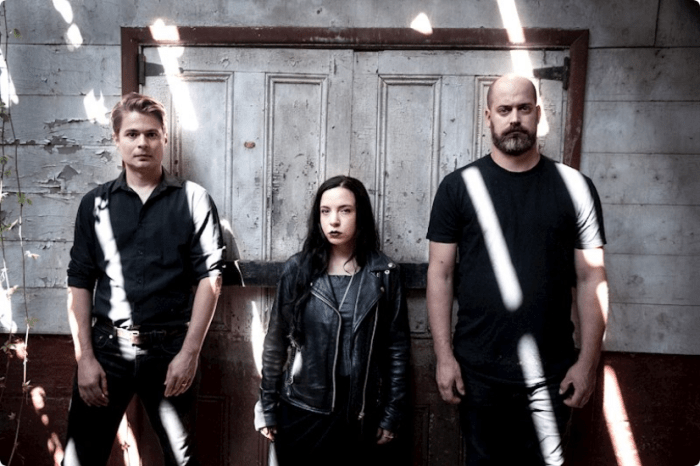
VÖLUR is:
- Laura C. Bates – violin, electric violin, viola, cymbals, vocals
- Lucas Gadke – electric bass, double bass, harmonium, keyboards, tanbur, clarinet, bass clarinet, vocals
- Justin Ruppel – drums, percussion

#Völur #BreathlessSpirit #GrettirTheStrong #IcelandicSaga #DoomMetal #ExperimentalMusic #FusionMusic #PersianMusic #KurdishMusic #SoundArt #MaxMSP #CanadianBands #InuitArt #SaimaiyuAkesuk #ConceptAlbum #PostMetal #FieldRecordings #ModernClassical #AncientLiterature #TorontoMusicScene #SonicStorytelling #ContemporaryFolk #Reamping #GranularSynthesis #AlbumProduction #CollaborativeComposition
Categories: Interviews, Music, Völur
 Capital Chaos TV
Leave a comment