

Achathras is a project steeped in the aesthetics of 90s European black metal, yet it refuses to be a museum piece. Instead, it aims to reawaken a particular feeling—a spark first lit in a teenage bedroom in the mid-nineties, when riffs, reverb, and raw mysticism cracked open the world. What follows is a deep dive into the artistic roots, ethos, and spectral identity behind A Darkness of the Ancient Past.
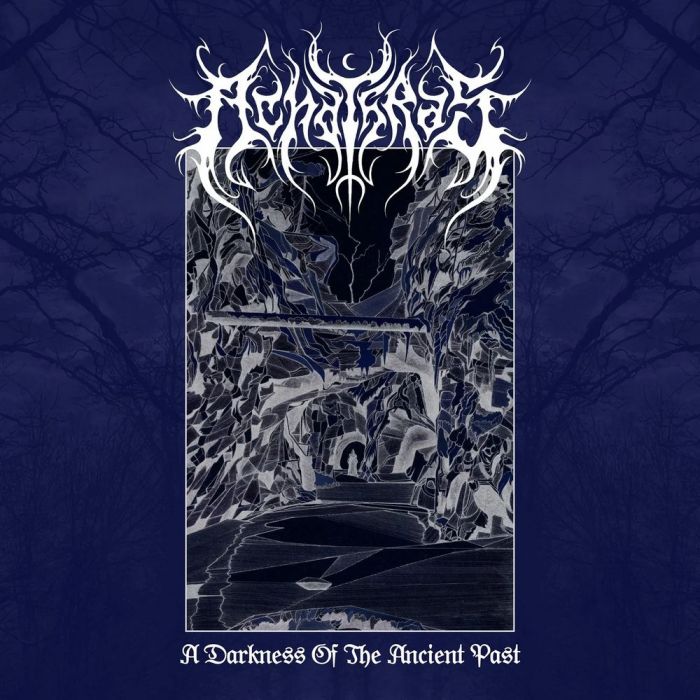
Your music draws heavily on 90s European black metal. What does that era represent to you artistically, and how did you seek to honor it without simply imitating it?
The mid-nineties black metal scene is my artistic foundation. I’d been playing guitar for a while, but it was black metal that truly enthused me and captured exactly what I wanted to do creatively. As a teenager, that period was one of cultural and spiritual awakening. The mystical, otherworldly quality of the genre captivated me, and even twenty-five years later, despite many sobering encounters with reality, that era still holds a kind of magic.
With Achathras, I’m not trying to recreate any specific band or recording. I’m trying to capture how I felt at that time. That approach helps me avoid simply replicating someone else’s sound. Achathras is essentially a musical dialogue with my younger self—using everything I’ve learned over the last quarter century to honor that early infatuation.
Given your anonymity and your roots in established bands, what freedoms or limitations did that bring to the songwriting and identity of Achathras?
Our experience in the wider scene is actually the main reason for the anonymity. I want people to approach Achathras without the baggage of prior associations. I don’t think our identities would add anything meaningful—they would only distract.
Some musicians find anonymity creatively liberating, allowing them to transgress their own self-imposed rules. I relate to that somewhat, but for me, anonymity simply suits this kind of music. It prioritizes the listener’s own interpretation. My most formative black metal experiences were solitary, imagining the music as a window into another world. That’s what I want Achathras to offer.
Tracks like “Anointed With Moonfire” balance aggression with atmosphere. How do you approach songwriting to achieve that dynamic without compromising intensity or mood?
Honestly, I don’t have a tidy answer. I work very hard on songwriting, arrangements, and dynamics—everything is meticulously crafted, even if it doesn’t sound like it. Experience plays a big role here; for all the value of youthful energy, I’m simply better equipped to execute my ideas now than I was then.
My writing is fundamentally intuitive. I usually know instinctively when I’m on the right track, though I’ve wasted plenty of evenings trying to salvage ideas that were never right in the first place. I also don’t always trust my frustration in the moment, so I record everything—every version of every idea. There’s nothing worse than destroying something only to realise later it had potential.
Many bands today claim to be “true” or “old school.” What do those terms mean to you, and where does Achathras position itself within or against that ideology?
Those words have been part of black metal’s vocabulary for thirty years, and everyone has their own fierce opinions about them. The scene is now so vast and varied—far too much for any one person to fully sift through. Whether people like it or not, there’s room for black metal to manifest in many forms.
You can bluster about definitions and red lines all you want, but ultimately I think it’s just noise. Gatekeeping doesn’t achieve anything; the genre is too big, too blurred. Sure, there are bands I think give black metal a bad name, but I prefer to channel my energy into something productive rather than give those bands more attention.
My focus is simply on fulfilling my own spiritual and creative needs, expressing black metal in a way that is meaningful to me. Setting your own standards is far more worthwhile than complaining about what others are doing.
The album title A Darkness of the Ancient Past suggests a mythic or historical theme. Were there particular stories, philosophies, or cultural references that influenced the record’s concept?
Yes, though I’ve been careful not to include any explicit references or cues pointing toward a specific mythology, philosophy, or cultural artifact. I wanted the experience to remain as open as possible for the listener’s own interpretation.
Much like our anonymity, the point is to avoid distracting associations. For example, I love Tolkien and Summoning, but unless you’ve somehow avoided every version of The Lord of the Rings, you can’t listen to Summoning without those associations shaping the experience.
I’ve always loved black metal lyrics that create an evocative vignette—something you can step into. Mortiis’s lyrics for early Emperor are a prime example. Their satanic themes are clear, but the lyrics still have a dreamlike, transportive quality. That’s what I tried to evoke with Achathras.
The guitar tone on “Anointed With Moonfire” is razor-sharp and icy. Can you share any details about the gear or recording approach used to achieve that classic 90s feel?
It’s a bit embarrassing to admit, but I recorded the guitars quite a long time ago and I honestly can’t remember the exact setup I used. What I can say is that the raw tracks were heavily EQ’d in the mix and ended up sounding far better than my original home-recorded versions.
The album was mixed by our drummer, Vorthol, who also has decades of experience with this style. His work was crucial in shaping that tone.
If the moon itself were to attend an Achathras performance—fully “anointed with moonfire”—what kind of crowd would it summon, and what merch would it buy?
Considering that Achathras performing live feels like the more far-fetched part of the scenario—we have no plans for shows at the moment—I imagine the moon’s presence would draw out lunar worshippers from across all sorts of esoteric and pagan subcultures. The band would be largely incidental.
As for merch… it would have to be a flag.
As A Darkness of the Ancient Past unfurls its cold, spectral landscapes, Achathras stands as a reminder that black metal’s greatest power lies not in imitation but in invocation. This is music shaped by memory, sharpened by experience, and illuminated by the moonfire of imagination. Whether the project remains a studio-bound specter or one day steps onto a stage, its presence is already unmistakable—a voice calling from the shadows, inviting listeners to wander beyond the veil.
Categories: Achathras, Interviews
 Capital Chaos TV
Leave a comment