

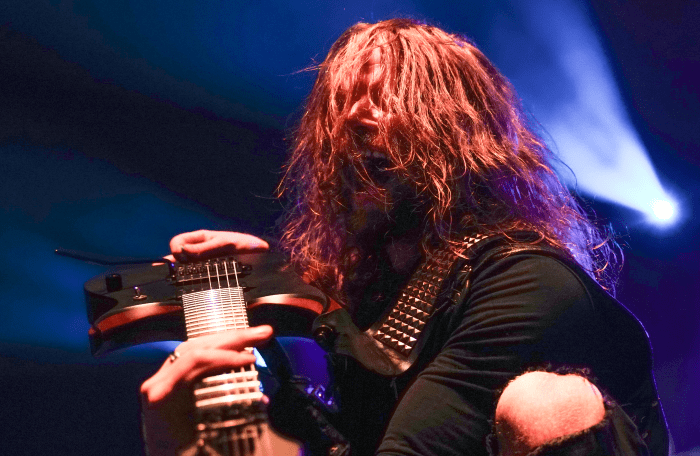
It was a hell of a night—sweaty, bruised from the pit, but charged with adrenaline. The air still thick with the chaos of a brutal death metal set, Aldo Guzman had the chance to talk to one of the most intense voices in the genre right now: Kyle Rasmussen, guitarist and vocalist of Vitriol.

I heard about you guys just a few months back — maybe two or three. And man, I was blown away. It’s a different breed of death metal. I don’t like throwing bands into hyper-specific subgenres, but even if I tried, I don’t think I could. You guys are original as hell — and that’s something that’s missing in death metal these days.
So, I was scrolling through your Facebook page and Googling you guys. The first thing I saw was a bold phrase: “Punishment. Cruelty. Death.” Each word with a period. Brutal. Can you break down the meaning behind that?
Yeah — that was actually the first thing we posted when we launched Vitriol’s social media. I wanted the aesthetic statement of Vitriol to match the sonic statement. I wanted to make extreme metal that didn’t pull any punches — not sonically, not conceptually.
A lot of death metal now hides behind symbolism and artistic flourishes that soften the blow of what should be intense, heavy subject matter. I think we’ve lost touch with some of the harsh realities that death metal is uniquely positioned to confront.
So for me, that phrase — “Punishment. Cruelty. Death.” — it just cut straight to the point. That’s what Vitriol is about. That’s what we’re meditating on. It’s not about promoting one specific idea, but rather about digging into the difficult concepts we feel need to be faced head-on.
I’ve got a heavy bag at home. I like to box. And your music made me want to keep going — to push harder. At the same time, it also made me feel a little depressed, but in a good way. It hit me deep. So thanks for doing what you do. Originality really means something.
Now, let’s get into the heart of it — what’s been the biggest challenge for you or for Vitriol in this scene?
Honestly? Originality. When you’re not operating within an established subgenre or trend, it’s a double-edged sword. It’s high-risk, high-reward. There’s no built-in audience, no scene to coast into. You really have to work hard to show people what you see — what you’re trying to create.
Context is everything. When you’re just starting a band, you forget that no one else shares the image you have in your head. It takes work to build that bridge. For Vitriol, before the merch, the music videos, or any of the visuals, it was just the music. And people didn’t know where to put us.
People want labels. Is it tech death? Is it blackened death? Old-school? None of those really applied. So it was hard to break through the noise. But when it finally clicked — when people got it — it started to work. Now we’re enjoying the ride.
I always say to people — “Just listen to this. It’ll mess you up.” And that’s the best way I can explain it.
But it’s tough, especially for newer fans. They rely on tastemakers to tell them what’s worth their time. You need those few people who say, “No, really, check this out.” And that’s how new movements start.
So on that note, what would you change about death metal — whether in the community, the scene, or the industry?
I’d love to see a creative shift back toward cultivating emotional connection in extreme metal. Over the last 15 years or so, the scene has been co-opted by athletes — players focused on technical prowess. And while that’s important for musical growth, it’s not sustainable without a message.
It’s like having a massive vocabulary but nothing meaningful to say.
Extreme metal needs more artistry. I got into this genre because it lit a fire in me. It made me feel less alone in my traumas. It pushed me to grow in healthy ways. But that kind of emotional relationship with the music isn’t prioritized anymore.
That’s what I want to change — and that’s Vitriol’s mission. To validate the emotional potency of this genre. Death metal shouldn’t just be acrobatics. It should mean something.
My favorite track on the album is “The Rope Calls You Brother.” Took a few listens to really hit, but now it’s the one I keep coming back to. Can you dive into the meaning behind it?
Absolutely. That track, and others like Victim, reflect the more introspective side of Vitriol. Not just outward hostility, but internal struggle. It’s not “I want to kill someone.” It’s “What’s inside me that makes me feel this way?”
Rope is about suicidal ideation. About living with that shadow always by your side. Feeling like that’s always an option. All of us in the band have struggled with that — and we’ve lost people we love to it. It’s very personal.
The middle section of the song, the long, black metal-inspired passage — that was the moment where I knew the lyrics had found their home. That space captured the mood perfectly.
That section hit me hard. It’s that drawn-out silence — but you already know what it means. It messes you up when you can relate to something that specific.
Exactly. That kind of rage you hear in metal often stems from deep pain. But metal tends to focus on the end result — the anger, the destruction — not the origin story. The vulnerability. The hurt.
Nobody is born wanting to watch the world burn. The world makes you that way.
So with Rope, we wanted to explore that origin story. That feeling of always having that exit option looming behind you.
When I was writing lyrics, I found myself getting angry just thinking about the stuff I was writing about. I’d fall into that mental pit and it was hard to get out. Do you need to get into that dark place to perform well?
Yeah — I mean, I don’t get hyped up backstage or slap myself in the mirror or anything like that. But once I step on stage, the shift just happens. It’s second nature now.
The hard part is writing. When you’re being honest with your lyrics, you have to go to that dark place. You have to feel it — and that can wear on you. It’s a fine line between catharsis and dwelling.
There’ve been times in this band where I’ve been completely lost in it. It’s easy to forget that good things exist when you’re submerged in that world 24/7. So you have to learn to compartmentalize, or it’ll consume you.
That balance is hard to strike. But it’s clear that you’re doing something special. You’re not just making brutal music — you’re making something real.
Thanks, man. That means a lot.
We’ve got fans who deeply connect with the lyrics and the intent — and we’ve got fans who are just there to blast weed and enjoy the riffs. And that’s cool too. There are layers. That’s what Vitriol is about.
We put serious thought into the songwriting and the lyrics, but we’re not above dropping a filthy breakdown. It’s about the full experience. And ultimately, we want to speak to the whole spectrum of the human condition — from the primal to the profound.
Catch Vitriol on tour and stream To Bathe from the Throat of Cowardice wherever you get your music.
Watch the full video interview below.
Interview by Aldo Guzman | Editing by Capital Chaos TV
Categories: Interviews, Vitriol
 Capital Chaos TV
Leave a comment