

With A Crack In Everything, In the Company of Serpents deliver their most personal and emotionally raw album to date. Trading esoteric metaphors for brutally honest reflections on addiction and recovery, guitarist and vocalist Grant Netzorg speaks to us about the record’s lyrical evolution, its cathartic creation, and why playing it drunk would defeat the point entirely.
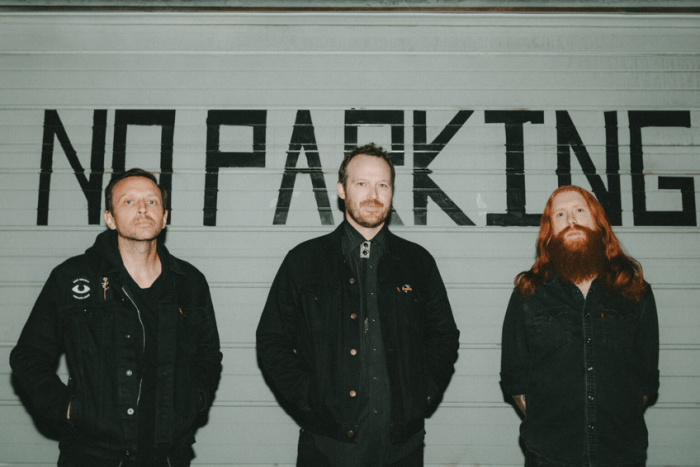
Photo by Kate Rose
“A Crack In Everything” marks a thematic shift from esotericism to personal struggle. How did this change in lyrical direction influence your songwriting and sound on this record?
My addiction had come to dominate everything in my life at that point, and this inevitably informed the writing of all the songs I was working on at the time. Musically, it is a continuation of the direction we’d already been headed in, but these are definitely the most personal lyrics I’ve done for the band. There were elements of personal things in previous work- Lux had a lot to do with the birth of my daughter, albeit through the lens of light as a metaphysical concept, Merging in Light dealt with my marriage using alchemical symbolism, etc.- however I employed a lot of esoteric symbolism to somewhat shroud the meaning in those songs. With this one, it is pretty plainly and directly about alcoholism, and the things I experienced dealing with it. There is still some measure of esotericism there, but this a much more lyrically-direct record.
You’ve mentioned Leonard Cohen’s “Anthem” as a key inspiration. How did that song shape the emotional and conceptual core of the album?
It didn’t really shape the sound, but the lyrics served as an apt metaphor for what I wanted to convey with this record. I am a longtime fan of Cohen’s, and was fortunate enough to see him live twice before he passed, so he has been an influence of mine for most of my adult life, even if that is not readily apparent in our music. I consider him the greatest lyricist of all time, and it’s not even a close competition.
“Anthem” includes the chorus, “There is a crack in everything: that’s how the light gets in,” which is where we got the title, and it beautifully conveys the sentiment I was going for in this album. It’s a record about utter despair and darkness, but also finding a way out of it. In the darkest depths, light still seeps in, even if only in infinitesimally small amounts. Light has been a prominent theme in our lyrics across our last three releases prior to this, and this was our way of continuing to explore it in a manner that was unique to this subject matter.
With much of the record written during a battle with alcoholism, how did the process of creating this album serve as a tool for healing or transformation for you personally?
This is where the esotericism still comes into play for me on this one. I view the whole record as something of hypersigil, where the core of it is a cord-cutting ritual. In essence, that operation entails envisioning all undesired aspects of one’s self personified as a grotesque being that is tethered to you. The thrust of the ritual is in severing that connection and subsequently banishing the entity and all it represented.
There’s also an element of Jungian shadow work involved here, as it is also about acknowledging this dark side of one’s self, facing it, and seeing what it has to say. It is there for a reason, and I needed to learn what it was trying to teach me.
In all, this is a very uncomfortable record for me to speak about, as I feel very vulnerable about exposing myself like this. However, I value honesty, and being direct about this allows some healing and therapy in its own right. It also keeps me accountable- it’d be pretty fucking uncool if I wrote a record like this, and then went out on the road getting hammered while performing it!
Your music has always balanced heaviness with atmospheric and cinematic elements. How do you strike that balance between sludge aggression and those more sparse, western-inspired passages?
I always have appreciated music with an intense contrast of dynamics, especially when there is a somewhat cinematic element to it, so I have consciously worked to incorporate that into our work. It has been present in just about everything we’ve done from our second record-on, when I began to incorporate minor key drones on a lap steel guitar along with eerie acoustic passages. I picked up the lap steel drones from watching Kristof Hahn perform with Swans, who are the mountaintop of this sort of music as far as I am concerned.
“Endless Well” was sparked by a riff idea from Captain Beefheart — what drew you to re imagine that specific riff in a doom/sludge context, and how did it evolve from its original inspiration?
Trout Mask Replica is a sublimely weird record that I’ve enjoyed for ages, and the song Moonlight on Vermont always stuck out to me as one of the strongest on the album. Whenever I heard that jangly, treble-heavy guitar in the beginning of the song, I could imagine it in my head as the basis for much heavier tune. So, we set out to try and write it! I initially began playing with a riff for this over ten years ago, but it never materialized into anything until the last year or two. In fact, I had almost scrapped this song entirely until Andy, our drummer, came in with a tom-heavy part for the intro riff that salvaged it in my ears.
The record is described as a kind of “cord-cutting” ritual. Can you talk more about how the music acts as a spiritual or symbolic release for you, and what that process looked like in the studio?
I spoke about it in more detail above when you were asking about how this record has been a healing process for me, so I’ll try to expand upon that without retreading too much ground.
So, the album functions as a sort of hypersigil. A sigil in the context of chaos magic is basically a glyph that the operant uses in ritual which represents a desired result or outcome that they are trying to elicit. A heypersigil is basically a broader working where this sort of intent is imbued in an entire creative work, as opposed to a one-off symbol. A famous (and awesome) example of a hypersigil is Grant Morrison’s comic, The Invisibles.
The song “Cinders” is directly this sort of operation, but the whole album can be seen as a functioning hypersigil dealing with my alcoholism.
In the studio we were pretty much down to business, and not much ritual was involved beyond some high-quality resin frankincense being burned. That said, I would have still been engaged in private, personal rituals before coming into the studio each day.
If A Crack In Everything were accidentally played backwards during a séance, what kind of spectral being would show up — and would it critique your guitar tone or ask to join the band?
I don’t know if I’d want to really evoke that, as it’d most likely involve re-tethering myself to the grotesque entity I was attempting to banish in the first place! He’d probably show up stinking drunk and maudlin, with strong opinions on the guitar tones that sober me would likely agree with. That would be the extent of our common ground, hopefully.
In the Company of Serpents‘ A Crack In Everything out July 11th—an intense, unflinching work of shadow, sludge, and spiritual severance. Listen with open ears and maybe light a candle… just in case
A Crack In Everything Track Listing:
1. Don’t Look In The Mirror
2. A Patchwork Art
3. Delirium
4. Cinders
5. Endless Well
6. Buzzard Logic
7. Tremens
8. Until Death Darkens Our Door
9. Ghosts On The Periphery
Categories: IN THE COMPANY OF SERPENTS, Interviews, Music
 Capital Chaos TV
Leave a comment