

From the vast steppes of Inner Mongolia to stages across the world, Nine Treasures have built their sound on a rare fusion of tradition and thunder — where the ancient voice of the Morin khuur meets the relentless pulse of modern metal. Their new album, Seeking The Absolute, dives deep into identity, honesty, and transformation — stripping away excess to uncover the soul beneath. We sat down with the band to talk about creative rebirth, sonic balance, and the spiritual heartbeat that drives their music.
“Until Now” was born from a place of creative uncertainty — what helped you push through that fog and find clarity in your songwriting process?
That period was both frustrating and liberating. We had written so much music that didn’t feel right — it was like chasing something we couldn’t define. The turning point came when we stopped overthinking and simply played together, letting emotions lead instead of logic. Once we let go of expectation, “Until Now” appeared almost naturally. It reminded us why we started making music in the first place — to express something real, not perfect.
You scrapped over twenty songs while creating Seeking The Absolute. How did those discarded ideas influence what finally made it onto the album?
Every song we let go of was part of the journey. Even though they didn’t make the final cut, they taught us what didn’t belong — which in turn helped us recognize what truly did. The discarded material stripped away the noise, leaving only the essence of what we were trying to say. In a way, they were necessary sacrifices for clarity.
Your music merges traditional Mongolian instruments with metal in a way few bands do. How do you approach balancing authenticity with innovation?
We never want the traditional instruments to feel like decoration. They’re at the heart of our sound, not an accessory. The goal has always been to let the Morin khuur, throat singing, and traditional rhythms breathe naturally within the heaviness of metal. We experiment with tone, structure, and emotion — but always with respect for where the music comes from. That’s how we keep both worlds alive and honest.
You’ve performed for crowds as large as 50,000 in Asia. How do you anticipate Western audiences will respond to your sound and visual identity?
We think Western audiences will connect to the emotion and energy, even if the language and instruments are different. Our sound might feel unfamiliar at first, but the spirit behind it — power, joy, unity — is universal. We’ve seen that connection happen everywhere we’ve played, and it’s always beautiful to witness people from completely different backgrounds move to the same rhythm.
The album includes stream-of-consciousness improvisation. What role does spontaneity play in a genre often associated with precision and structure?
Spontaneity is what keeps our music alive. Metal is often tight and calculated, but we like to leave space for accidents — for moments that surprise even us. When we record or perform, sometimes the most powerful parts come from pure instinct. That’s where the spirit of the song reveals itself.
Askhan, you mentioned seeking something “more honest” in this album. Can you elaborate on what ‘honesty’ means to you in a musical context?
Honesty means removing the mask. It’s about not hiding behind complexity or production. It’s playing exactly what you feel, even if it’s imperfect or raw. For me, Seeking The Absolute was about facing ourselves — as musicians and as people — and expressing that truth directly through sound.
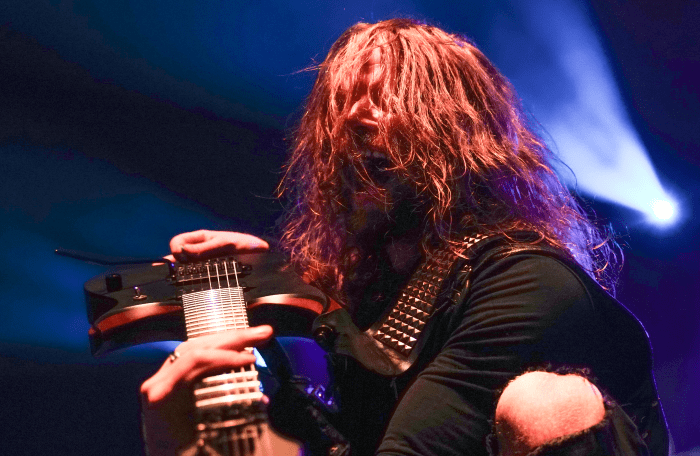
Askhan, can you walk us through your current guitar and effects setup, and how it interacts with traditional instruments like the Morin khuur and Tovshuur during live shows?
My setup is pretty straightforward — it’s all about clarity and dynamics rather than heavy effects. Saina and I both play Gibson Les Paul guitars through Driftwood tube amps to get that natural, organic saturation. Since the guitars need to leave space for the Morin khuur’s tone to shine, I focus on precise EQ and midrange balance. The Morin khuur and Tovshuur sit in a very distinct frequency range, so we blend them carefully to make the mix feel natural — like they’re having a conversation with the guitars rather than competing with them. At every show, we fine-tune that dialogue between the traditional and the modern to keep it alive and evolving.
If the Morin khuur was secretly a mythical creature in disguise, what kind of powers would it have and which band member would it choose as its rider?
Nine Treasures: The Morin khuur would be a guardian spirit — ancient, wise, and capable of summoning the sound of the steppe itself. Its power would be to unite hearts through sound. And we think it would choose Narsa, our Morin khuur player, of course. He understands its voice better than anyone else. Together, they’d ride across the endless grasslands, carrying stories from the past into the present.

With Seeking The Absolute, Nine Treasures have carved out a space where heritage and heaviness coexist in harmony — a sound that transcends geography and language, reaching something deeper and more human. It’s an album that doesn’t just showcase musicianship, but self-discovery; a reminder that the pursuit of truth in art is as infinite as the steppe winds that inspired it. As they continue to bridge worlds with every note, Nine Treasures stand as proof that music, at its core, is a shared heartbeat — ancient, loud, and alive.
Categories: Interviews, Nine Treasures
 Capital Chaos TV
Leave a comment